
Concrete coatings for South Central Kentucky
Epoxy Flooring in Bowling Green, KY
Garage, shop and basement floors built for hot summers, humid air and slabs that sit on limestone.
- Free on-site estimate with a slab and moisture check
- Itemized written quote before any work begins
- Every floor diamond ground and patched before coating
Coatings Made for Bowling Green Concrete
Epoxy flooring in Bowling Green has to deal with two things most cost guides never mention: heat and the ground under the slab. Wikipedia's climate data for the city shows about 41 days a year at 90°F or higher, and July days average 78.7°F around the clock. Below the concrete is karst, limestone riddled with caves and sinkholes. A floor coating here needs a slab that has been checked for cracks and movement, and it needs a topcoat that can take hot tires in August.
Built on karst
The Kentucky Geological Survey estimates that more than half of Kentucky sits above karst. Bowling Green knows this well. In February 2014 a sinkhole opened under the Skydome at the National Corvette Museum and swallowed eight Corvettes. After a storm in April 2025 that dropped more than ten inches of rain in four days, WKYU reported that the city geologist had counted at least 18 new sinkholes. He explained that the clay topsoil over the limestone gets heavier and more plastic when it is soaked. Most garages will never see a sinkhole, but that same soil movement shows up on a smaller scale as cracked, settled or uneven slabs. We look for those cracks first and tell you which ones can be filled and coated and which ones point to a bigger problem.
A young, fast-growing housing stock
Most homes here are fairly new. American Community Survey figures (2019 to 2023) summarized by Point2Homes put the median year built in Bowling Green at 1991, with 18% of units built in the 2000s and another 17.2% in the 2010s. Warren County as a whole grew 18.2% between the 2010 and 2020 censuses. Newer slabs usually need less patching, but builder-grade concrete can still have a weak, dusty surface, curing compounds and early shrinkage cracks. Grinding removes that top layer so the coating bonds to solid concrete.
Heat, humidity and hot tires
Bowling Green has a humid subtropical climate. Long hot stretches matter for garage floors because hot tires soften cheap coatings and pull them up, a problem known as hot tire pickup. Thin water-based kit coatings are the usual victims. We use thicker, 100% solids base coats on ground concrete, and we often top them with polyaspartic, which HomeGuide rates as having excellent UV resistance compared with poor to fair for epoxy. That matters for any garage that sits with the door open in the afternoon sun.
Floors we coat
- Garages: one-, two- and three-car garages, attached or detached, with flake or solid color finishes.
- Workshops and pole barns: concrete floors in outbuildings that see tools, mowers and trucks.
- Basements and bonus rooms: finished spaces where a metallic or solid color floor replaces carpet.
- Commercial floors: shops, small warehouses, retail sales floors and back-of-house areas.
- Repairs: crack filling, spall repair and leveling small low spots before the coating.
How a typical garage job runs
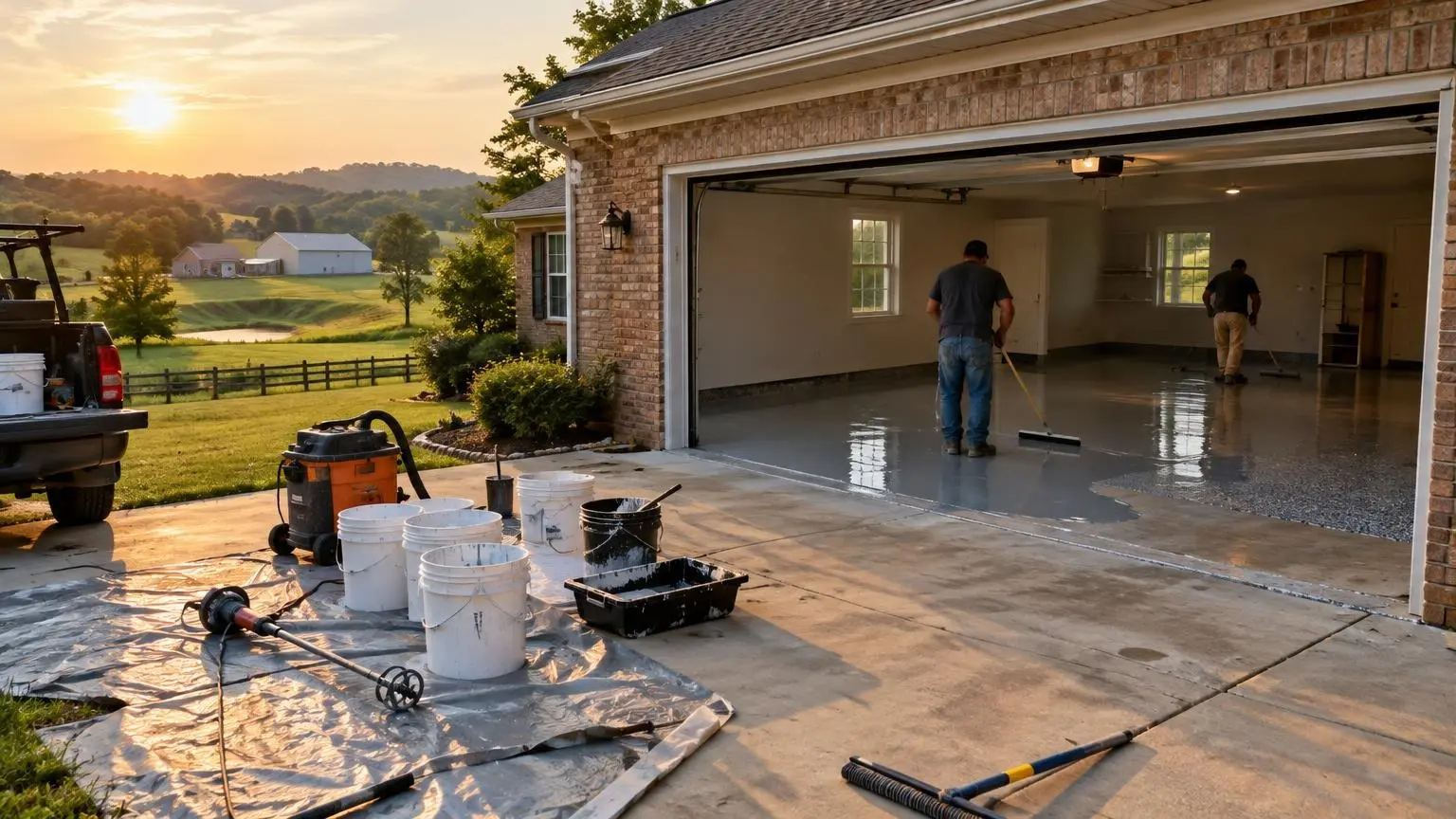
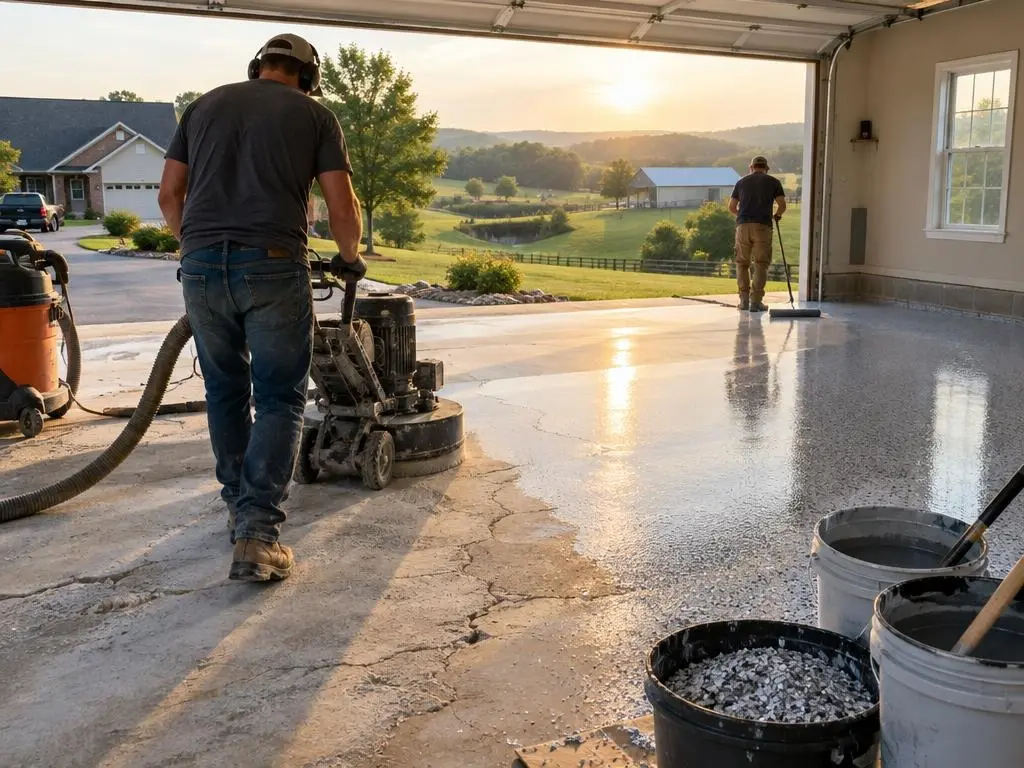
1. We clear the floor plan with you and note what needs to be moved. 2. The whole slab is diamond ground and vacuumed, edges included. 3. Cracks, chips and pitted areas are filled and ground flush. 4. The base coat goes down, followed by flakes or a color coat. 5. A clear topcoat seals it, with texture added if you want extra grip. 6. You get written cure times for walking, moving items back and parking.
Most residential garages are done in one to two days, depending on the system and the weather.
What it costs
HomeGuide's national figures put installed epoxy at $4 to $10 per square foot, or about $1,600 to $5,800 for a two-car garage. Polyaspartic runs $5 to $12 per square foot. HomeAdvisor reports an average epoxy floor job of $2,526. Your total depends on the size, how much repair the slab needs and the finish you pick. We give one written number after we have seen the floor.
Why Homeowners Call Epoxy Flooring Bowling Green
We check the ground under the floor
In karst country, cracks can mean movement. We look at every crack and tell you whether it can be filled and coated or needs other work first.
Coatings chosen for heat
Thick base coats and UV-stable topcoats hold up to hot tires and sun through Kentucky summers.
Grinding on every job
Every floor is diamond ground to open the concrete and remove weak surface, curing compound and old sealers.
One price in writing
Your quote lists the square footage, the prep, each coat and the total. Changes are written up and approved by you first.
Common Questions
How much does epoxy flooring cost in Bowling Green?
HomeGuide's national range is $4 to $10 per square foot installed, which works out to about $1,600 to $5,800 for a two-car garage. Polyaspartic systems run about $5 to $12 per square foot. Crack repair, old coating removal and decorative finishes add to that. We give you a written price after seeing your floor.
What are the disadvantages of epoxy flooring?
Standard epoxy needs a clean, dry, well-ground slab, or it can peel. HomeGuide notes it can take up to a week to fully cure, it is more brittle than polyaspartic, and it can yellow in sunlight without a UV-stable topcoat. A glossy floor can also be slick when wet. We deal with each of these through prep, a polyaspartic topcoat where it fits and added texture.
How expensive is metallic epoxy?
This Old House puts metallic epoxy floors at about $5 to $12 per square foot. A 400 square foot basement room would land around $2,000 to $4,800 at that rate. The price goes up with more colors, more complex designs and any slab repair needed first.
Is epoxy flooring good for restaurants?
Resin floors are common in commercial spaces because they are seamless and easy to clean, and we can add grit to the topcoat for traction. Kitchens with hot oil, steam cleaning and boiling water can be hard on standard epoxy. For those areas we discuss heavier, heat-tolerant systems before quoting.
Do sinkholes and karst affect a garage floor coating?
Karst mostly affects a coating through soil movement under the slab, which shows up as cracks and settled sections. A coating can bridge small, stable cracks once they are filled. It cannot stop a slab from moving, so we tell you if a crack looks active before you pay for a new floor.
How long before I can park on a new garage floor?
HomeGuide says to wait 2 to 7 days before driving on standard epoxy and 24 to 48 hours for polyaspartic. Temperature and humidity change those times. We give you exact times for your floor in writing.
Can I just use a store-bought epoxy kit?
Kits cost about $200 to $700 according to HomeGuide, and water-based versions usually need recoating every 3 to 5 years. Most rely on acid etching instead of grinding, and thin kit coatings are prone to hot tire pickup in a Kentucky summer. A ground slab and a thicker system last much longer.
Our Floor Coating Services
Six services for the concrete you actually have in South Central Kentucky, from hot-tire garages to cracked slabs and busy shop floors.
Garage Floor Coating
A tough, sealed garage floor that handles hot tires, spilled fluids and Kentucky humidity, starting with grinding and crack repair.
Learn more →Epoxy Flake Floors
Colored vinyl chips broadcast into epoxy for a textured, forgiving floor that hides dust and adds grip.
Learn more →Polyaspartic Floor Coating
A fast-curing, UV-stable coating that can have you parking in a day or two and holds its color in the sun.
Learn more →Metallic Epoxy Floors
Poured, swirled metallic finishes for basements, bonus rooms, home bars and retail spaces.
Learn more →Shop & Commercial Floor Epoxy
Thicker resin systems for workshops, warehouses, auto bays, retail spaces and restaurant back rooms.
Learn more →Concrete Crack & Slab Repair
Crack filling, spall patching and surface repair before a coating, with an honest read on cracks that point to bigger problems.
Learn more →
Where We Work
Bowling Green is home base. We also coat floors across Warren County, including Plum Springs, Smiths Grove, Oakland, Woodburn, Alvaton, Rockfield and Richardsville, and in the neighboring counties: Franklin, Scottsville, Russellville, Auburn, Lewisburg, Adairville, Glasgow, Park City, Cave City, Morgantown and Brownsville, plus Portland and Westmoreland just across the Tennessee line. The work changes with the place. Newer subdivisions around Bowling Green have attached garages with fairly young slabs. Older farm towns have detached garages and outbuildings with patched concrete. Industrial towns like Russellville and Glasgow have more shop and plant-adjacent work. Each area page covers what we know about that town.
- Epoxy Flooring in Bowling Green, KY
- Epoxy Flooring in Plum Springs, KY
- Epoxy Flooring in Smiths Grove, KY
- Epoxy Flooring in Oakland, KY
- Epoxy Flooring in Woodburn, KY
- Epoxy Flooring in Alvaton, KY
- Epoxy Flooring in Rockfield, KY
- Epoxy Flooring in Richardsville, KY
- Epoxy Flooring in Franklin, KY
- Epoxy Flooring in Scottsville, KY
- Epoxy Flooring in Russellville, KY
- Epoxy Flooring in Auburn, KY
- Epoxy Flooring in Lewisburg, KY
- Epoxy Flooring in Adairville, KY
- Epoxy Flooring in Glasgow, KY
- Epoxy Flooring in Park City, KY
- Epoxy Flooring in Cave City, KY
- Epoxy Flooring in Brownsville, KY
- Epoxy Flooring in Morgantown, KY
- Epoxy Flooring in Portland, TN
- Epoxy Flooring in Westmoreland, TN
Get an Epoxy Flooring Estimate
Free on-site estimates in Bowling Green and across South Central Kentucky.